Evaluate a model
ReIDModel.evaluate measures how accurately a model matches people. How evaluation works explains what is compared; the sections after it show the code.
How evaluation works
Query and gallery
Re-ID works as a search. The crop of the person you want to find is the query, and the crops you search are the gallery. The model ranks the gallery by the distance of each crop to the query, closest first. A good model ranks the gallery crops of the same person at the top.
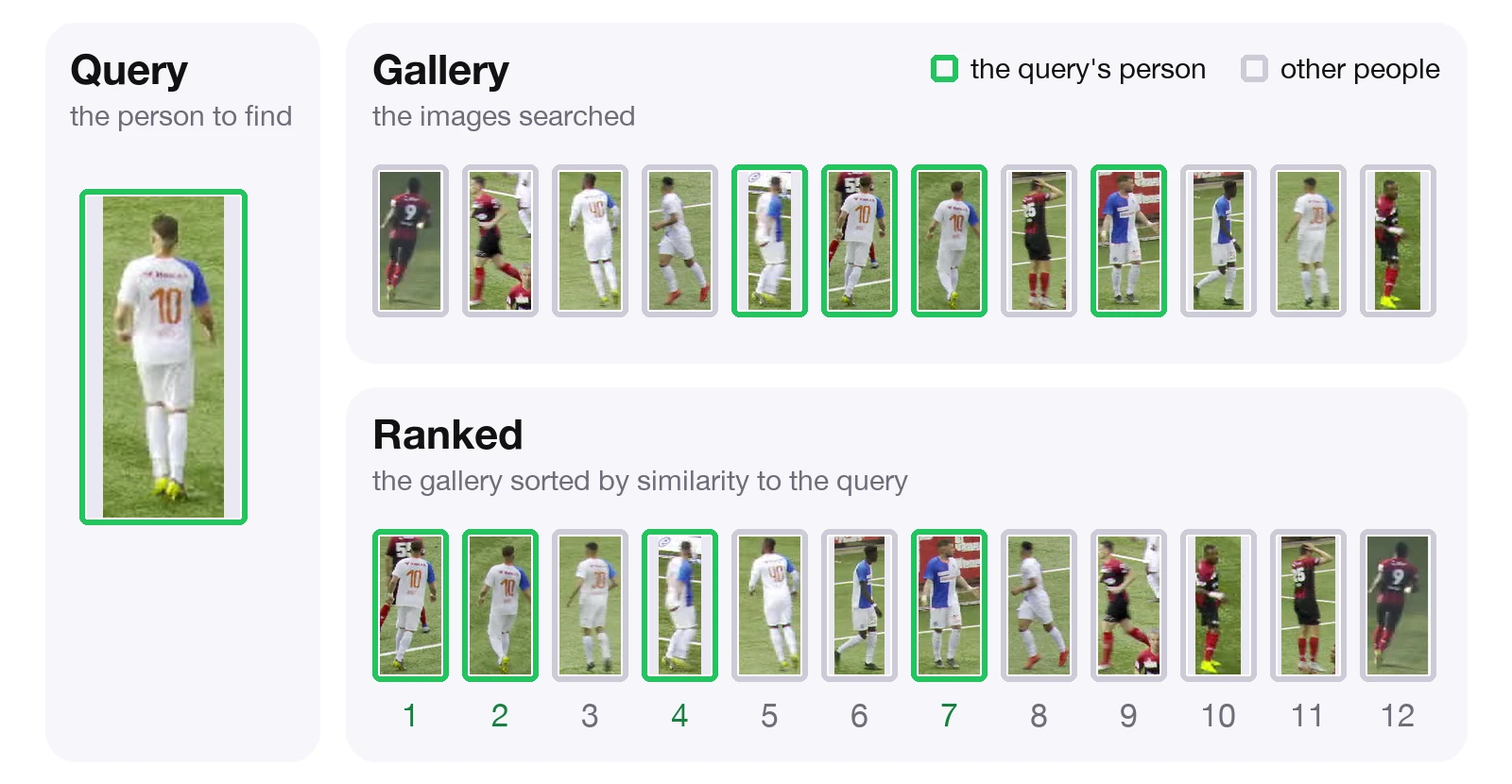
One query from a SoccerNet clip, ranked by the default model against 12 crops from the game's other clips. The query's person lands at ranks 1, 2, 4, and 7. Which images the gallery holds depends on the evaluation setup.
Query set and gallery set
To measure a model, you repeat that search for many people. The test images are split into a query set and a gallery set: Market-1501 and MSMT17 ship this split, and for your own identity folders RetrievalProtocol takes one query image of each person with at least two images and puts their other images in the gallery set. Each query is ranked against the whole gallery set, and the metrics summarize how high the correct matches land.
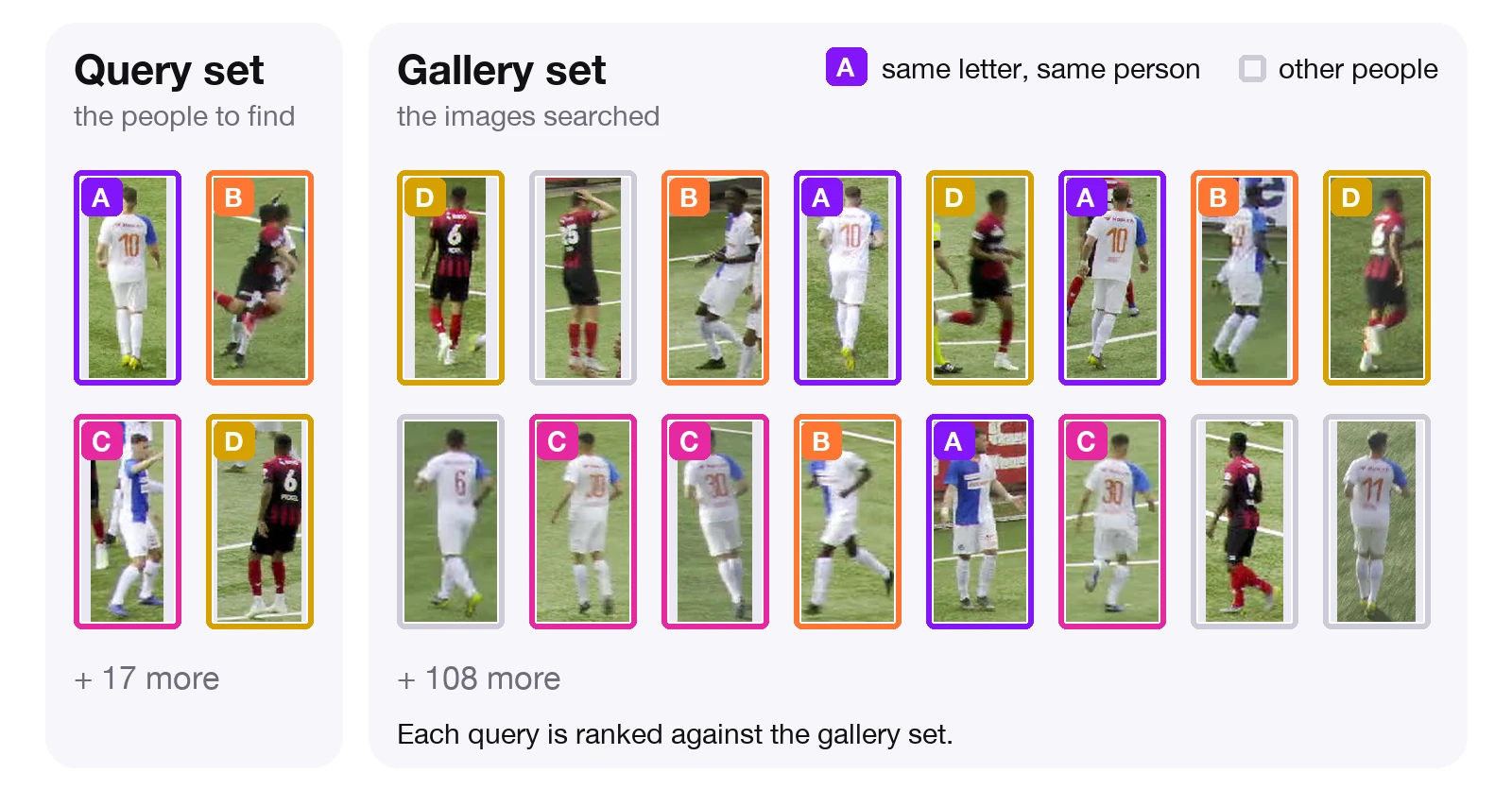
RetrievalProtocol with its defaults on SoccerNet identity folders: one query for each of the 21 people with at least two images, ranked against their other 124 images.
Whether a gallery image is a match, a distractor, or junk is decided for each query, so the same image can count differently for two queries. An image of person 5 from camera 1 is junk for a query of person 5 from camera 1, and a match for a query of person 5 from camera 2.
| Term | Meaning |
|---|---|
| Match | Gallery image of the query's person from a different camera |
| Distractor | Gallery image of anyone else; it counts as a wrong candidate |
| Junk | Gallery image ignored when ranking: the query's person from the same camera, or a bad detection |
Junk entries are removed from the query's ranked list before scoring. They never count as hits or as wrong candidates that push a hit down the ranking. Same-camera images of the query's person are junk because the goal is to find the person in other cameras.
Distance
The distance between two embeddings can be computed in more than one way. Both protocols take a distance argument, as in RetrievalProtocol(distance=...):
distance |
Behavior |
|---|---|
"cosine" (default) |
Cosine distance after L2-normalizing embeddings |
"euclidean" |
Euclidean distance on the raw embedding vectors |
Rankings, and so metrics, change with the distance, so use the same one for every run you compare, and the one a published table used when you compare against it.
from reid.eval import RetrievalProtocol

result = model.evaluate(query, gallery, protocol=RetrievalProtocol(distance="euclidean"))
print(result.metrics)
Outside an evaluation, for example to find each person again in a later frame, distance_matrix computes the same distances between embeddings you extracted yourself: one row per query, smaller is closer.
from reid import distance_matrix

query_embeddings = model.extract_embeddings(detections, frame)
gallery_embeddings = model.extract_embeddings(later_detections, later_frame)
closest = distance_matrix(query_embeddings, gallery_embeddings).argmin(axis=1)  # later_detections must not be empty
Retrieval or re-association
Evaluate a model the way you will use it: the queries and gallery should look like the comparisons the model makes in your application.
- Retrieval asks whether the model finds a person in other cameras. Market-1501 and MSMT17 measure this, and
RetrievalProtocoldoes it on your own identity folders. - Re-association asks whether the model finds a person again a number of frames later in the same video. When Re-ID helps a tracker such as Roboflow Trackers associate people across frames, this is the comparison it makes.
ReassociationProtocoltakes a person's crop at one frame as the query, ranks the people who have a crop in the same sequence a set number of frames later, and records the rank of that same person. Retrieval on the same crops would overstate this ability, because a query's closest gallery images are usually the same person a few frames apart.
Evaluate on a benchmark or your own images
Market-1501 and MSMT17 provide their own query and gallery splits; pass these directly to the model.
from reid import ReIDModel, load_market1501

model = ReIDModel.from_pretrained()
query, gallery = load_market1501("/path/to/Market-1501")
result = model.evaluate(query, gallery)

print(result.metrics)
# {'map': ..., 'rank1': ..., 'rank5': ..., 'rank10': ..., 'minp': ...}
print(result.num_queries)
# 3368
To evaluate your own images, either arrange them like Market-1501 or MSMT17 and load them with load_market1501 or load_msmt17, or put them in identity folders, one per person (<root>/<identity>/<image>.jpg), and load them with load_identity_folders. RetrievalProtocol then splits them: it picks queries_per_id random images of each person as queries, using seed, and puts the rest in the gallery, so every query has a correct match to find. People with fewer than min_crops images are left out:
from reid import load_identity_folders
from reid.eval import RetrievalProtocol

data = load_identity_folders("/path/to/identity/folders")

result = model.evaluate(data, protocol=RetrievalProtocol(queries_per_id=2, min_crops=3, seed=7))
Omit protocol to use retrieval with one query per identity. The same data and protocol, including its seed, always select the same images, so evaluating several models this way compares them on identical inputs. RetrievalProtocol(...).build_query_gallery(data) returns the query and gallery images it evaluates, the candidate mask (None for retrieval), and the metadata. To compare query and gallery images you chose yourself, build a ReIDSplit for each and pass both to model.evaluate.
result.metrics is a dictionary with metric names as keys and percentages as values. For retrieval, map (mean average precision) measures ranking across all correct matches, rank1, rank5, and rank10 report the percentage of queries with a correct match among the 1, 5, or 10 gallery images closest to the query, and minp (mean inverse negative penalty) reflects the position of the last correct match. Re-association reports rank1 and mrr instead, described below. Re-ID metrics gives each metric's formula. result.num_queries counts queries included in the metrics; result.metadata records the protocol settings and the number of query and gallery images.
Retrieval uses cosine distance by default; set RetrievalProtocol(distance="euclidean") when the benchmark specifies Euclidean distance. Evaluation keeps the whole query-by-gallery distance matrix in memory, 4 bytes per pair, so check the size before evaluating a large dataset: MSMT17's official split, 11,659 queries by 82,161 gallery images, needs about 3.8 GB.
Crops from video
Re-association evaluates crops cut from video. generate_mot_patches builds its input from sequences with MOT-format ground truth (a gt/gt.txt file and an img1/ frame folder per sequence): one folder per identity (<sequence>_<track_id>) with one crop per box, named by frame.
from reid import load_identity_folders
from reid.data.mot import generate_mot_patches
from reid.eval import ReassociationProtocol

generate_mot_patches(mot_root="/path/to/dancetrack/val", output_dir="/path/to/crops", split="full")

crops = load_identity_folders("/path/to/crops")
result = model.evaluate(crops, protocol=ReassociationProtocol(gap_frames=30, query_stride=60))
print(result.metrics)
split chooses which frames of each sequence are cropped:
split |
Frames cropped |
|---|---|
"full" |
every frame |
"train_half" (default) |
frames 1 to L // 2 + 1 of a sequence of L frames (1 to 451 of 900) |
"val_half" |
the remaining frames, L // 2 + 2 to L (452 to 900 of 900) |
This is the MOT17 half split used in the tracking literature, for example by ByteTrack, so the train half has one frame more than the val half when L is even.
Use "full" for sequences kept only for evaluation. Use "train_half" and "val_half" when training and evaluating on the same sequences, so no frame is used for both. Boxes with confidence 0, which MOTChallenge ground truth uses to mark boxes to ignore, are always skipped. Among the boxes with a nonzero confidence, class_ids keeps only the listed ground-truth classes.
Re-association reports rank1, the percentage of queries whose correct match is the closest of their candidates, and mrr, the mean reciprocal rank: each query scores 1/r, where r is the rank of its correct match (1 at rank 1, 1/2 at rank 2), and mrr averages these scores. Each query has exactly one correct match, so mean average precision is the mean reciprocal rank.
Re-association scores rankings of saved crops; it does not run a tracker or decide any match. Set gap_frames to the gaps your tracker has to bridge, and measure tracking performance separately with Roboflow Trackers.
Limit which gallery images each query is ranked against
By default, each query is ranked against the whole gallery. A candidate set limits a query to some of the gallery images. ReassociationProtocol builds one for every query: with gap_frames=30, a query at frame 100 is ranked only against the crops at frame 130 of the same sequence. People without a crop there, such as someone whose box the visibility or size filters dropped, are not candidates, and a query whose own person has no crop there is skipped.
To define your own candidate sets, subclass a protocol and return a candidate mask from _build_query_gallery. The mask is a boolean array shaped (num_queries, num_gallery): True keeps a gallery image in that query's ranking, and False removes it from both the ranking and the count of correct matches. This protocol ranks each query only against gallery images from the same scene:
import numpy as np

from reid.eval import RetrievalProtocol


class SameSceneRetrieval(RetrievalProtocol):
    def __init__(self, scene_of, **kwargs):
        super().__init__(**kwargs)
        self.scene_of = scene_of

    def _build_query_gallery(self, data, gallery=None):
        query, gallery, _, metadata = super()._build_query_gallery(data, gallery)
        query_scenes = np.array([self.scene_of[path] for path in query.image_paths])
        gallery_scenes = np.array([self.scene_of[path] for path in gallery.image_paths])
        return query, gallery, query_scenes[:, None] == gallery_scenes[None, :], metadata


result = model.evaluate(data, protocol=SameSceneRetrieval(scene_of))
Camera and junk-ID filtering still apply inside the candidate set. Set exclude_same_pid_camid = False on the class when same-person, same-camera matches should count, as in re-association. Queries with no correct match among their candidates are left out of the averages and of num_queries; if no query can be scored, evaluate raises a ValueError. The distance matrix is still computed in full, including the pairs outside the candidate sets, so it takes the same memory as without a mask.